
Most of my conversations with clients in the United States start the same way.
They don’t ask me about the price first.
They ask me one simple thing:
“Will the quality stay the same after my first order?”
And honestly, I understand why.
I’m Ashish Dhawan, and I’ve spent years watching how this industry works, especially from the factory side. The biggest problem isn’t finding hair. It’s finding consistency you can actually rely on.
That’s why, before any order leaves my factory for the USA, there’s a process it goes through,h not rushed, not outsourced, and definitely not compromised.
It always begins in South India.
The hair we work with comes through our direct sourcing network connected to temples like Tirupati. By the time it reaches us, it hasn’t been altered or processed. It’s raw, exactly as it was collected. For me, this stage matters more than anything else, because if the sourcing is wrong, nothing you do later can fix it.
When the hair arrives at our factory, the real work begins, and it’s not done by machines.
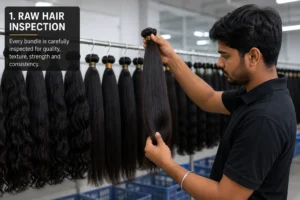
We sit down and sort everything manually.
The first separation is always between single donor hair and premium mixed hair. After that, we go deep, per grouping by length, by natural texture, by how the hair actually falls and behaves. This part takes time, and honestly, it should. I’ve never believed in rushing something that directly affects someone else’s business.
Once sorted, the next decision is just as important as what not to do.
We don’t use chemical processing. At all.
No shortcuts to make the hair look smoother. No artificial coatings to make it shine temporarily. I’ve seen too many buyers in the USA deal with hair that looks good for a week and then completely changes. That’s not something I’m willing to send out from my factory.
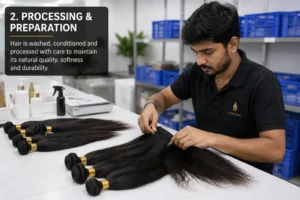
So we keep it simple. Clean handling. Careful treatment. Nothing that interferes with the natural cuticle or texture.
From there, the hair moves into one of the most detailed stages, hackling.
We still do this by hand.
It’s slower, yes. But it gives us control. Depending on what the client needs, we prepare either single-drawn or double-drawn hair. Some of my USA clients prefer a more natural look, others want uniform thickness,s and this is where that difference is created.
By the time we reach bundling, everything is already defined.
Each bundle is prepared at 100 grams, but more importantly, it’s checked for consistency. I always remind my team that the client receiving this order might compare it directly with their last one. If it doesn’t match, we’ve failed.
For weft orders, we use our own machines inside the factory. That’s another part of the process I don’t outsource, because once you lose control, you lose consistency. Keeping everything in-house helps me stand by what I send.
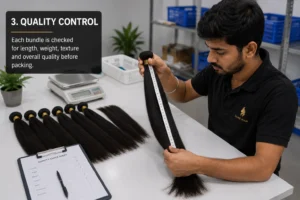
Before anything is packed, there’s always a final look.
Not a checklist. Not a formality.
An actual, physical check of the hair texture, length, and overall feel. If something doesn’t sit right, it doesn’t go forward. It’s that simple.
Once everything is ready, we pack and dispatch using partners like DHL and FedEx. Most shipments reach the USA within 3 to 4 days, but speed is never the priority; accuracy is.
Because at the end of all this, I know one thing:
The person receiving that package isn’t just opening a box.
They’re deciding whether they can trust me again.
And that’s how I look at every order.
Not as a transaction, but as the beginning or continuation of a relationship.
Most of my long-term clients in the USA didn’t start with large orders. They started by asking questions, understanding the process, and seeing if what I say matches what I deliver.
If you’re in the same position, that’s exactly where I’d suggest you begin.
Not with volume.
Not with pricing.
But with clarity.
Because once you understand how your supplier actually works, everything else becomes much easier to scale.